The day, in short
Two parts. In the morning, "Zoom Out": the big picture, with technology, demographics, geopolitics. In the afternoon, "Back to Earth": what can actually be done, now, in companies and in everyday life. All on a starship set, with Star Trek lines on stage and an "Engage!" before the break.
What Romanians think about AI
The day started from an Impactum Insights survey of 1,000 Romanians, run for the summit in early October:
- 89% have used at least one AI tool, and 61% use one weekly;
- 24% of those who work use it unofficially on the job;
- 49% want AI training but have no access to it;
- 68% see the future of work as a human + AI collaboration.
For me, the second and third numbers say it all. People are already there. Organisations are not yet. What is missing is the frame: who uses what, for what, with which data, and who answers for the result.
What I noted from the speakers
Riaz Shah: technology at warp speed, people at human speed
The opening keynote put three forces side by side: technology, demographics and attitudes. For Romania, the numbers were heavy: 4.2 million fewer people than in 1990, an estimated shortage of about 600,000 workers and, at the same time, about 570,000 young people who neither work nor study.
The line that stayed on the slide: the hard part is not the technology, it is leading people, at human speed, through a change they didn't ask for.
I also noted "Don't plan. Prototype.", from the Marshmallow Challenge, where children build taller towers than MBA graduates because they try instead of planning.
Sergiu Manea: a signal without action is just information
The BCR CEO talked about crises as decision points and about the Cynefin framework: in complex contexts you don't understand through analysis, but through experiment and action.
One concrete example stayed with me: the credit report in George Business, which shows companies how the bank sees them. From it I noted an idea of my own: any service provider would gain from making transparent the processes it now keeps "secret". The credit process is just the first example.
Mo Gawdat: augmented intelligence, not replacement
Mo talked about AI as an increase in our capacity, not a replacement: you "borrow" IQ points from the model, but the thinking stays yours. I noted two things:
- the practical advice to have several models check each other, rather than trusting a single one;
- his observation that "regulate us" requests can also be a way of shifting responsibility away from those who build.
Andi Petreanu: execution has been democratised
Execution is getting cheaper. Judgement is not.
The line from Andi's slide is the one I take with me. He took the challenge "what can you really build in one day with AI?" and broke it down hour by hour, along with everything still unsolved afterwards. His conclusion had three pillars of human value: taste, relationships ("deals are not made between agents") and responsibility.
His warning also made me think: "human in the loop" can become a mere rubber stamp. The agent gives you exactly what you need in order to approve, and you approve.
It connects to what I was asking myself after Prow: if execution becomes cheap for everyone, the advantage moves to judgement, to clarity, to knowing what is worth doing.
The Centaur Economy: 50% human, 50% AI
The panel with Diana Stafie, Bogdan Putinică, Virgil Tornoreanu and Paul Olteanu was, for me, the closest to everyday work.
- Diana Stafie ran an exercise with a manager in 2030, with 20 colleagues and 10 AI agents: which tasks stay human, which are augmented, which are automated and which are new. The conclusion on the slide: managing the agents becomes part of the job.
- Bogdan Putinică had the clearest line about agents: "We delegate the work. We keep the accountability." AI acts within approved limits, and the company decides who answers.
- Virgil Tornoreanu, author of "The Centaur Economy", the book every attendee received, laid out five possible futures and chose the centaur one: human and machine, together.
- Paul Olteanu talked about the nervous system and the speed of AI. On the slide: "priority zero: less surprise", plus the eight universal human needs, from safety and connection to autonomy and meaning.
During Paul's talk I wrote down something I can't get out of my head: human + AI + process. As a BA and PO, process is practically my job. A good process does exactly what Paul described for the nervous system: it reduces surprise. It says who does what, where the human steps in, where AI steps in, and who answers at the end. Without it, AI doesn't make us faster. It makes us more tired.
Nancy Rademaker: your next customer won't be human
Nancy started from how customers have changed: informed but oversaturated, impatient, deciding emotionally and justifying rationally, trusting other people more than companies. And one number I liked for how honest it is: most organisations have already integrated AI, but more than half of CEOs see neither revenue nor savings from it yet. The real question remains what is worth automating and what is not.
The Oxford debate
The motion: AI acceleration is taking us toward abundance, not collapse. FOR: Andrei Pitiș, Beniamin Mincu, Simona Olteanu. AGAINST: Mihnea Măruță, Paul Olteanu, Laura Drăgoi. Chair: Șerban Pitic.
It was the first Oxford-style debate I have watched live. Intense, with very good arguments on both sides. Simona Olteanu and Laura Drăgoi, "performance" debaters, delivered like in the films about Oxford and Cambridge.
Two lines stayed with me, one from each side:
- Simona Olteanu, for: control is a process problem, not an intelligence problem. Permissions, test environments, human in the loop, an external off switch. You don't need to understand the code to uninstall an app.
- Laura Drăgoi, against: we all came to that room for human connection, not for one more screen.
At the end, hugs and congratulations all round. That is what healthy disagreement looks like.
Divertis and their avatars
A moment I didn't expect at an AI summit: Divertis, perfectly adapted to 2026. Live comedy, plus their own AI avatars, with an "opinion poll by applause" presented by an avatar.
The people part
Because, as was said again and again on stage, human connection is still the most valuable thing. I am glad I finally met Paul Olteanu offline and that I met Dragoș Pătraru again, who warmly supported Paul, Mihnea Măruță and Laura Drăgoi in the debate. And it was a pleasant, somewhat unusual surprise to see the actor Claudiu Bleonț among the attendees.
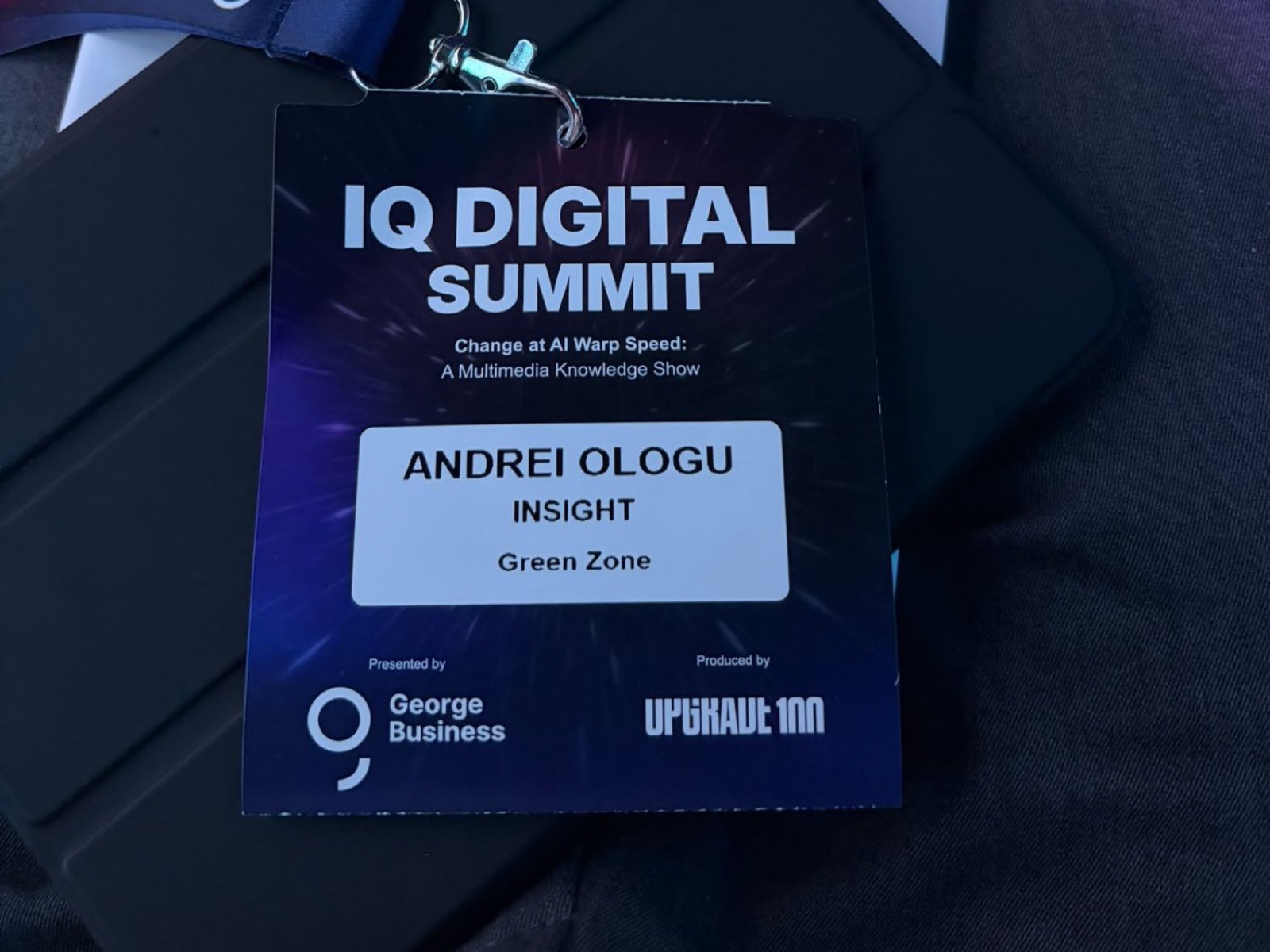 The badge: "Change at AI Warp Speed: A Multimedia Knowledge Show".
What I take away
- Human + AI + process. People already have AI. What most companies lack is the process that says how we use it and who answers for it.
- Judgement becomes the expensive part. When execution costs almost nothing, the value lies in knowing what is worth doing.
- We delegate the work, not the accountability. The more we work with agents, the more it matters who approves and who answers.
- Transparency as an advantage. The processes companies hide from their customers can become exactly the reason customers stay.
- Prototype before you plan. Especially where nobody knows the answer yet.
Thank you UPGRADE 100, Dragoș Stanca and Smaranda Heroiu for a day that was truly worth the 1,000 km trip.
I will write about some of these ideas in more depth over the coming weeks.


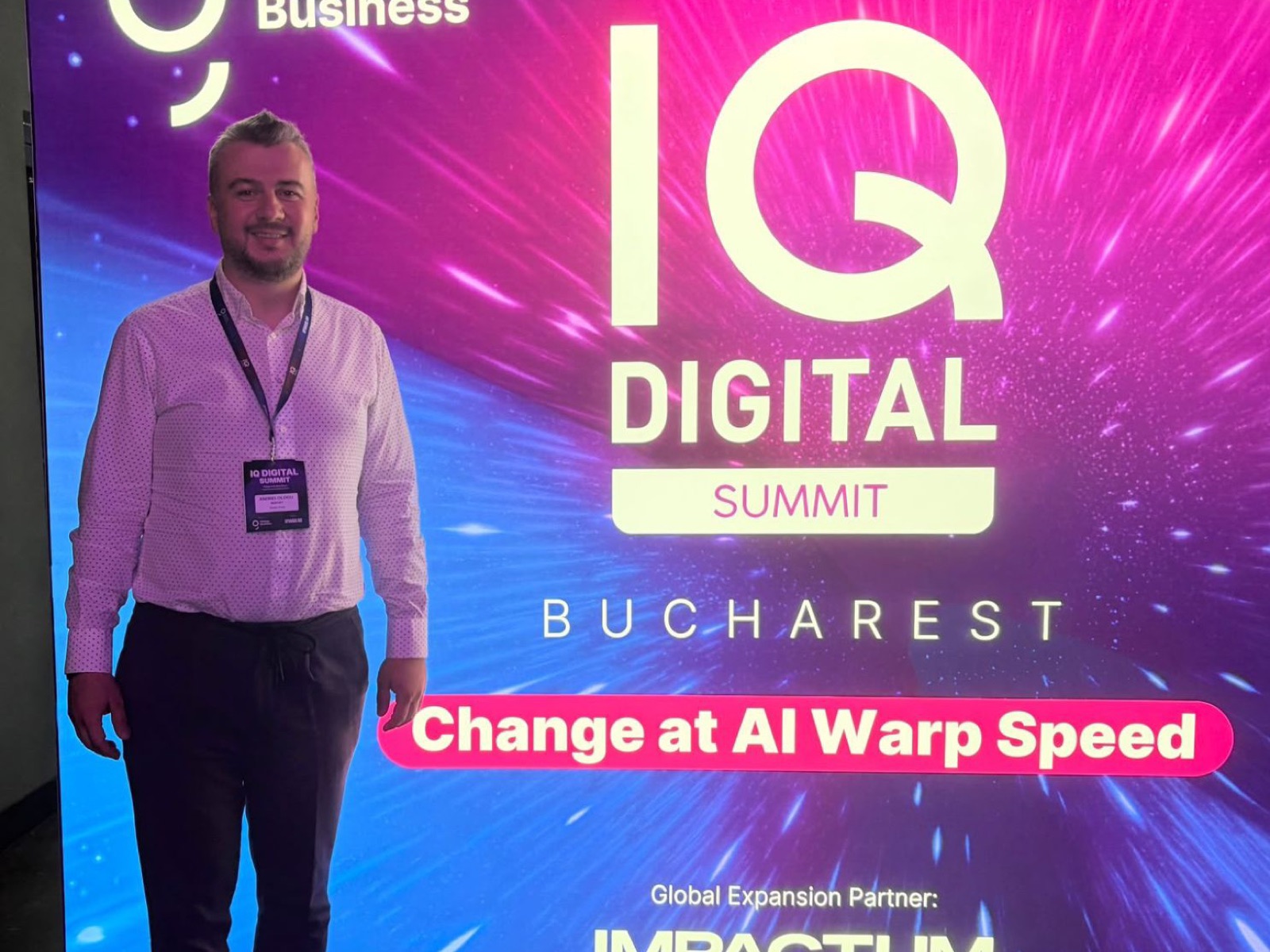 Change at AI Warp Speed, this year's theme.